Aggregating Small Coal Producers into One Export Cargo
Many South African coal producers have good material but not enough of it to fill a vessel alone. Combining several sources into one export cargo works well, provided the specification, the stockpile and the contract are settled before any coal moves.
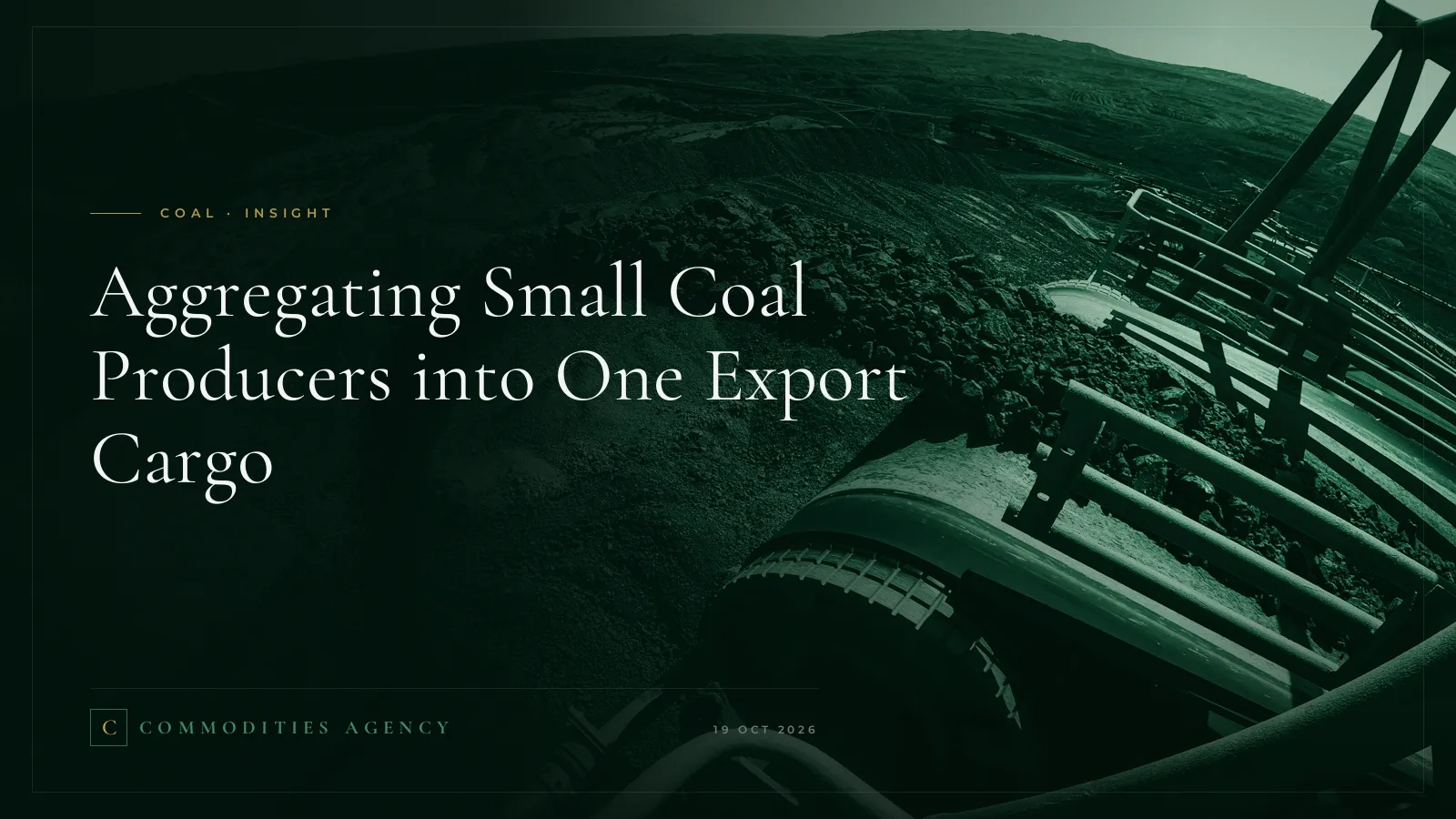
Most coal producers who come to a desk for the first time are not short of quality. They are short of scale. A single pit or a small washing operation may turn out good, consistent material month after month and still never fill an export vessel on its own. The trade is built around cargoes, and a buyer fixing a ship wants one seller, one specification and one loading window. Aggregation is how smaller producers close that gap: several sources combined into a single export cargo that is sold, sampled and shipped as one.
Done properly, it turns mine gate tonnes into an export price. Done badly, it produces an off-spec cargo, a disputed final assay and a buyer who will not come back. The difference is almost entirely in the preparation.
Why a buyer will not take three small parcels
A utility or trader buying thermal coal is paying for a delivered result: a calorific value, an ash and sulphur ceiling, a size range and a laycan. Every additional seller in the chain adds a contract, a set of documents and another party who can miss a train. Buyers would rather pay a fair price for one clean cargo than a slightly lower price for a bundle of separate parcels they have to manage themselves.
That is why aggregation has to happen on the seller side, before the offer goes out. The buyer should see a single cargo with a single specification and a single party standing behind it. How that cargo was assembled is the seller group's business, as long as the result is consistent and the paperwork is clean.
Start with the specification, not the tonnage
The first question for a group of producers is not how many tonnes they hold between them. It is whether their coal can be combined into something a buyer recognises. South African export coal is sold against grade bands, and a cargo that sits between bands is harder to sell than one that lands cleanly inside one. Our guide to RB1, RB2 and RB3 grades covers the main parameters buyers look at.
Each contributing producer should provide recent independent analyses covering calorific value on a net as received basis, ash, volatiles, sulphur, total moisture and sizing. Lay them side by side. Two sources with similar ash and volatiles but different calorific value can often be blended to a predictable middle. A source with high sulphur can pull an otherwise good cargo outside a buyer's limit, and no amount of blending at the margin will fix that if it makes up a large share of the stem.
Be honest about what the blend will be, not what the best contributor produces. Buyers price the final assay at the load port, and that is the number every producer in the group will be paid on.
Where the coal comes together
Aggregation needs a physical place: a rail siding, a private stockyard near a loading point, or a terminal stockpile where material from several sources can be received, weighed, sampled and blended before loading. The choice depends on the route. Rail into a coal terminal generally needs the material consolidated at a siding with a confirmed slot. Road into a port such as Maputo allows more flexibility on where material is staged, at a higher cost per tonne. Our earlier note on selling coal without Richards Bay entitlement covers the terminal access question in more detail.
Whatever the site, three things matter:
- Weighing on receipt. Every truck or wagon from every producer is weighed in, and the weighbridge tickets are kept. This is the basis of each producer's share.
- Sampling on receipt. Each contributor's material is sampled as it arrives, ideally by the same independent inspector who will sample at loading. If a cargo misses specification, this is how the group knows why.
- Controlled stacking. Material is stacked and reclaimed so the blend is consistent through the vessel, not one producer in the first hold and another in the last.
One seller on the contract
The buyer signs with one party. In practice that is either a lead producer who buys the other contributors' coal outright and sells the whole cargo in their own name, or a trading company that takes title from each producer and sells on. Both work. What does not work is a loose arrangement where several producers each expect to invoice the buyer directly.
The internal agreement between producers is where most aggregated cargoes succeed or fail. It should settle, in writing and before any coal moves:
- who holds title to the stockpile at each stage, and when it passes
- how each producer's tonnage is measured, and whose weighbridge counts
- how the final load port assay is applied back to each contributor, including what happens if one source drags the cargo below specification
- who carries demurrage if a producer misses its delivery window
- when each producer is paid, relative to when the buyer pays
Producers who skip this step usually discover the gaps at the worst possible moment, when the vessel is alongside and one contributor's trucks have not arrived.
Timing is the real constraint
A single producer only has to manage its own output. An aggregated cargo has to land every contributor's coal at the stockpile before the laycan opens. That means a delivery programme agreed in advance, with some tonnage held in reserve in case a contributor falls short. Quote the laycan that the slowest contributor can support, not the fastest. A buyer who has fixed a vessel against your date will not care which producer was late.
The logistics leg also has to be priced into each producer's netback from the start. Transport to the aggregation point, handling, stockpiling and sampling are real costs, and they need to be agreed before anyone compares the export price with what they would get at the mine gate.
What to bring to a desk
A group of producers looking to sell an aggregated cargo should be able to show the analyses for each source, a realistic combined specification, the monthly tonnage each contributor can deliver, the proposed aggregation site and route, and who will be the selling party on the contract. With that in hand, a desk can test the cargo with buyers quickly, and can often suggest where a blend will place best.
If you are a smaller producer, or already talking to neighbours about combining tonnage, tell us what you hold and where it sits. We will tell you plainly whether there is a cargo in it.
Thermal Coal
We place thermal coal with named international buyers. Tell us the grade, roughly how much you hold and where it sits, and you will know inside a trading day whether we have a buyer.