Steelpoort and Rustenburg: Inside the Bushveld Chrome Belt
The Bushveld Igneous Complex holds roughly three quarters of the world's chromite. How its eastern and western limbs differ, and what that means for sourcing.
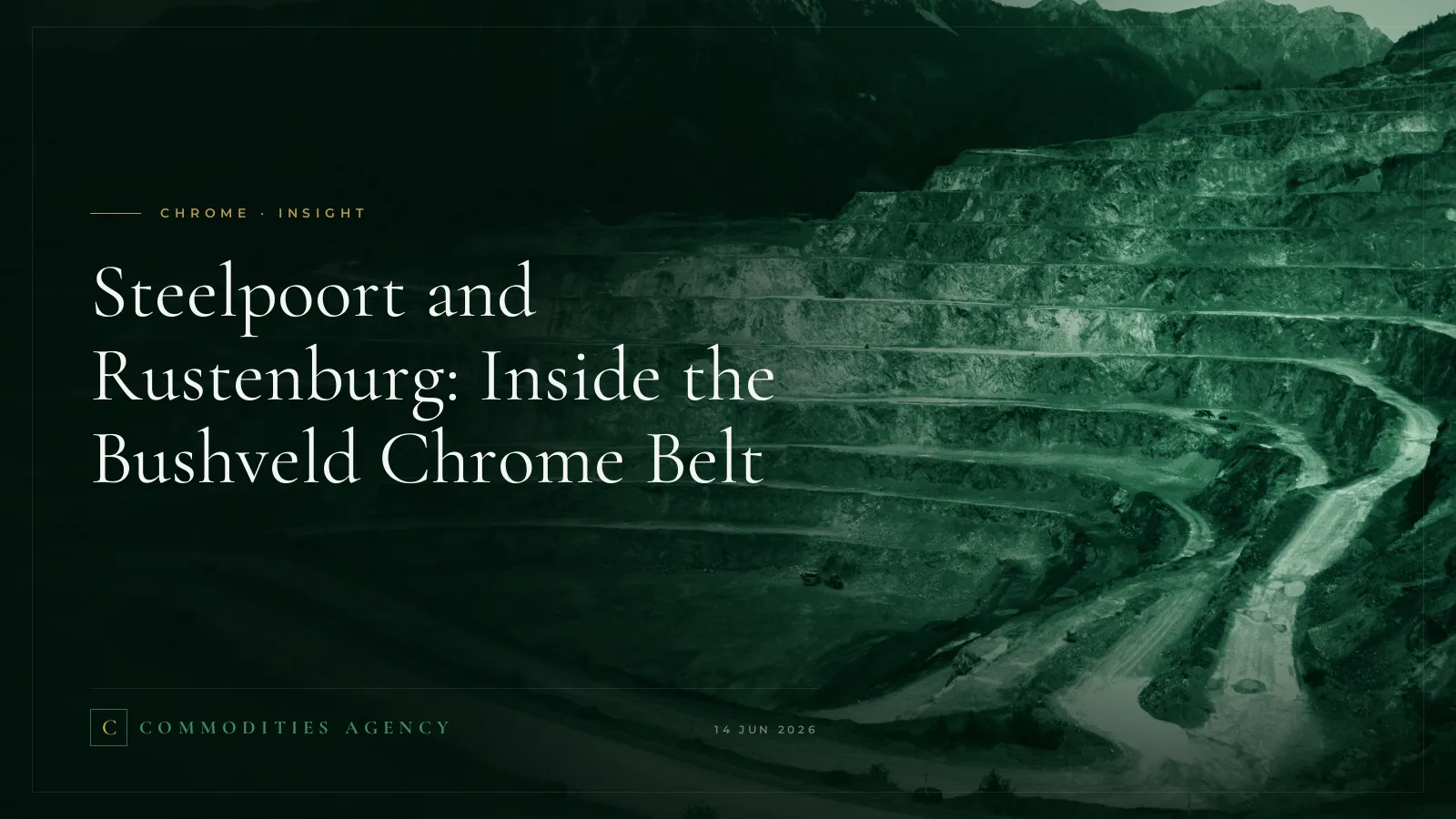
South Africa produces close to half of the world's chrome ore, and virtually all of it comes from a single geological feature: the Bushveld Igneous Complex, a two-billion-year-old layered intrusion spanning much of the country's north. For buyers, two names on that map matter most, Steelpoort on the eastern limb and Rustenburg on the western limb.
Steelpoort: the eastern limb
The Steelpoort valley in Limpopo and Mpumalanga hosts some of the densest chromite mining activity on earth, centred on the LG6 and MG seams. Material from this district feeds both local ferrochrome smelters and a substantial export trade. Road and rail links connect the valley to Richards Bay, and increasingly to Maputo, whose proximity has made it a favoured export route for eastern-limb tonnes when South African rail capacity tightens.
Rustenburg: the western limb
Rustenburg, in North West province, is better known globally for platinum, but chromite and PGMs occur in the same layered reefs, and the district produces large volumes of chrome concentrate, including as a by-product of platinum operations. By-product concentrate can be attractively priced, and Rustenburg's established mining infrastructure means consistent, well-documented supply.
What buyers check, and what sellers should have ready
Both districts produce the standard 40–42% Cr₂O₃ export concentrate, but provenance still matters:
- Assay discipline. Reputable sellers provide independent SGS or Intertek certificates on every stockpile, not historical mine averages.
- Moisture and sizing. Export concentrate is typically 0–1mm; moisture above contract spec quietly erodes payable tonnes.
- Logistics chain. Confirm whether the offer is ex-works, FCA loaded, or FOB port, the cost difference between Steelpoort and a vessel's rail is substantial and should be transparent.
Selling from the eastern or western limb
For a producer, the limb you sit on shapes the logistics more than the product. Eastern limb plants around Steelpoort and Burgersfort are closer to the Mozambican border, which makes Maputo a natural export route when South African rail is tight. Western limb plants around Rustenburg, Brits and Mooinooi sit within trucking distance of inland smelters and of delivered points around Johannesburg, so a good share of western limb material trades free on truck or delivered into local smelting rather than moving to a port.
By-product concentrate from platinum operations deserves a note. It can be very competitively priced, but it is produced to suit the platinum plant's schedule rather than a chrome buyer's, so volumes can move with platinum economics. Buyers who rely on it usually want a clear statement of how much is committed and for how long.
Whichever limb you produce on, the questions a buyer will ask are the same: the assay and who issued it, how much you can hold per week, where the material sits and on what basis you are selling. We set out the full list on our chrome concentrate page, and the grade differences in chrome concentrate grades explained. If you have material and want a straight answer on whether there is a buyer for it, send us an enquiry.
Chrome Concentrate
We place chrome concentrate with named international buyers. Tell us the grade, roughly how much you hold and where it sits, and you will know inside a trading day whether we have a buyer.