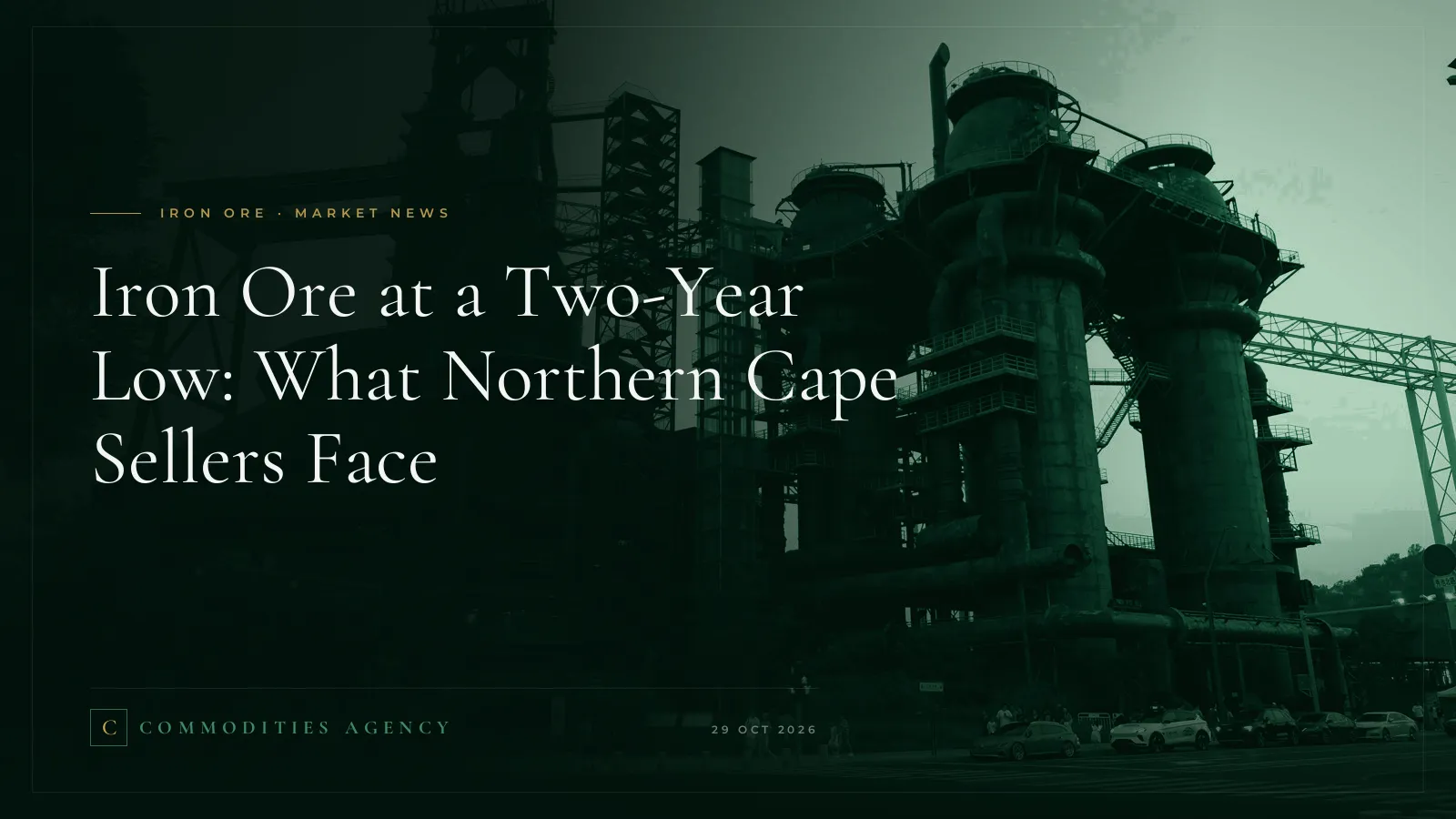
Iron Ore at a Two-Year Low: What Northern Cape Sellers Face
Iron ore futures slipped below $90 a tonne this week, their lowest since September 2024, as Chinese steel demand softened and supply kept growing. For Northern Cape producers paying record freight out of Saldanha, the squeeze on netbacks is sharper than the headline suggests.
Iron ore futures fell to their lowest level in more than two years on Tuesday 27 October. Benchmark futures in Singapore dropped as much as 1.4% to $89.25 a tonne, a level last seen in September 2024, and the most traded contract in Dalian also hit a two year low, according to Bloomberg reporting carried by Miningmx. The reasons are familiar ones: Chinese steel demand is entering its seasonally weakest stretch, mill margins are thin, port stocks in China are high, and new tonnes keep arriving.
Mengtian Jiang of Horizon Insights expects the weakness to run through November, with prices possibly sliding towards $85 to $86 a tonne. On the supply side, shipments from the four largest miners could rise by up to 18 million tonnes in the fourth quarter, while Guinea's Simandou mine continues to ramp up. With stocks high at Chinese ports, mills are buying as they need ore rather than building inventory.
What Kumba's quarter tells us about the South African position
The clearest local read comes from Kumba Iron Ore's third quarter update, released on 20 October. Kumba's year to date realised price averaged $86 per wet metric tonne FOB, a 9% premium to the $79 benchmark average, helped by its high share of lump. A year earlier it was $94 against $84. Chief executive Mpumi Zikalala put the pressure plainly: "Weaker Chinese steel production, compressed mill margins and strong seaborne supply weighed on prices."
Two other details matter for anyone exporting from the Northern Cape. Freight from Saldanha Bay to Qingdao rose to $32 a tonne in September, a five year high, against a year to date average of $23. And ore railed to Saldanha fell 8% to 9.4 million tonnes in the quarter, largely because of a derailment that affected 400,000 tonnes. On the positive side, Transnet has now replaced a third of its planned 517 km rail programme on the ore line, including 22 km during a ten day shutdown in October, which has lifted 40% of speed restrictions on the export channel.
Why a lower index hits smaller sellers harder
A producer selling FOT or FOR at the mine is paid what is left after everything between the stockpile and the Chinese port has been taken out of the CFR price. When the index falls while freight stays high, that remainder shrinks faster than the headline price does. The large miners have lump premiums, port stock and long term rail contracts to cushion the fall. A smaller operation selling fines by road and rail usually has none of those, so a few dollars off the index can turn a workable netback into a marginal one.
Grade also matters more in a soft market. Buyers with full stockyards become selective, and lower grade or high silica fines tend to see discounts widen before the index stops falling. We covered how lump and fines are judged in our guide to South African iron ore fines and lumpy.
What to watch through November
- Whether Singapore futures hold above the $85 to $86 range analysts have flagged, or break lower.
- Capesize freight out of Saldanha, which can move a netback as much as the index itself.
- Progress on the ore line rail replacement and the commissioning of Tippler 3 at Saldanha, which Kumba reports is under way.
- Chinese port inventories and whether mills start restocking ahead of the new year.
What sellers should do now
This is a market for knowing your numbers rather than chasing a price. Get an independent assay on the material you actually have on the floor, so any offer can be judged against grade rather than guesswork. Work out your netback at a range of index levels, not only today's, and know the point at which a sale stops covering mining and transport. If you hold lump, price it separately from fines. And where you have stock that has to move this year, start the conversation early, because buyers in a falling market take longer to commit.
Our iron ore desk tracks both the index and the freight leg, and our logistics team can help price the road, rail and port side. If you have material ready to place, you can submit your stock to the desk and we will tell you honestly what it is likely to fetch.
Sources
- Iron ore hits two-year low as demand weakens, Miningmx, 27 Oct 2026
- Iron ore market weakens amid record freight rates and rail woes, says Kumba, Miningmx, 20 Oct 2026
- Kumba's UHDMS project at Sishen cuts third-quarter production, Business Day, 20 Oct 2026
Iron Ore
We place iron ore with named international buyers. Tell us the grade, roughly how much you hold and where it sits, and you will know inside a trading day whether we have a buyer.