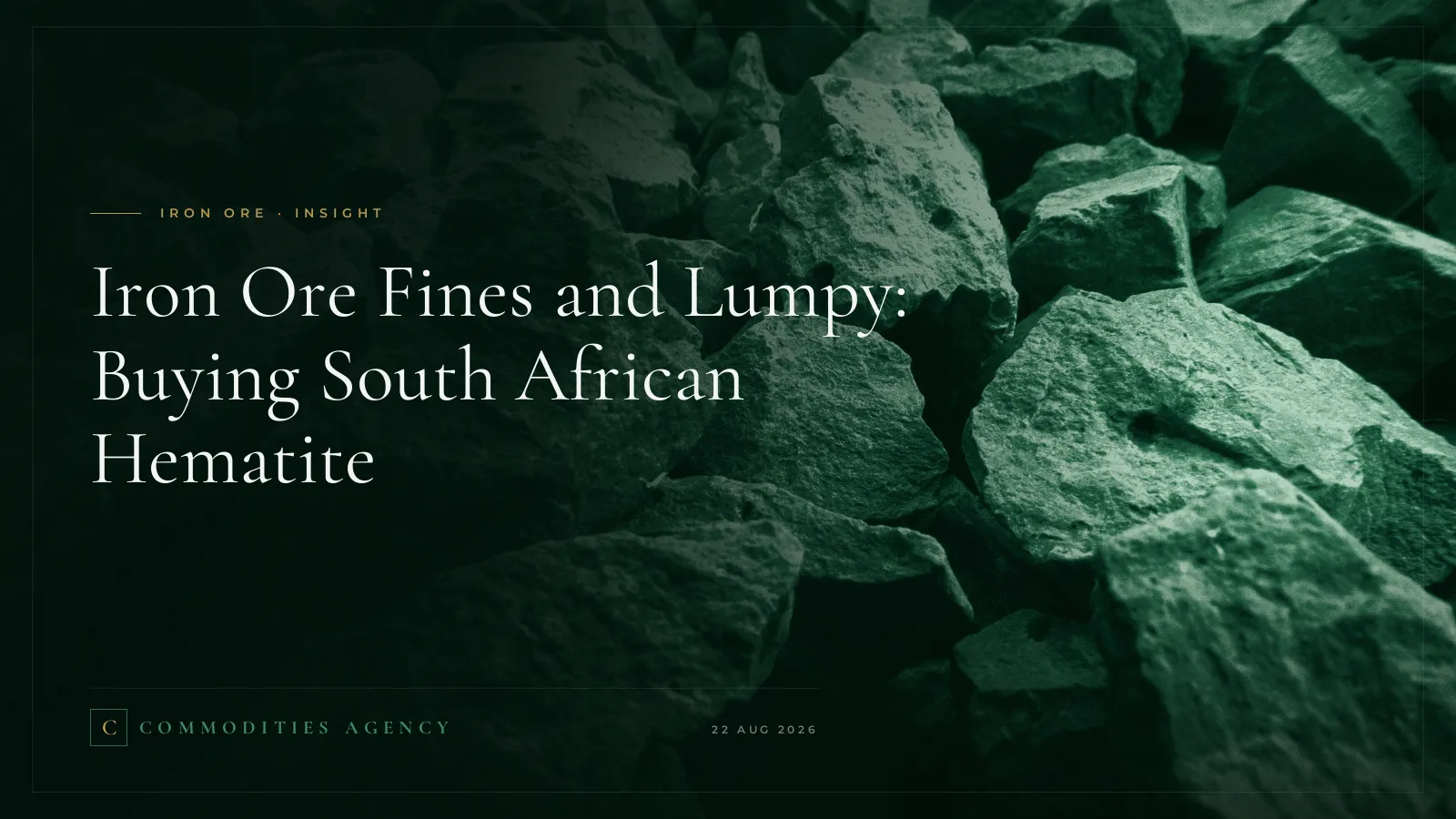
Iron Ore Fines and Lumpy: Buying South African Hematite
Fines and lumpy are priced differently because of what happens inside the blast furnace. How South African hematite is specified on a 62% Fe basis and moved.
South African hematite has a quiet reputation among mill buyers. It is not the largest source in the seaborne market, but it is consistently low in alumina and predictable enough that a blend can be planned around it. Understanding how it is sold starts with the distinction between fines and lumpy.
Why fines and lumpy are priced separately
The difference is physical. Lumpy ore is sized material that can be charged directly into a blast furnace. Fines are too small to charge directly because they would choke the gas flow through the burden, so they have to be agglomerated first, by sintering or pelletising, before the furnace can use them.
That extra processing step is why the two carry different prices. A mill with sinter capacity values fines because it can convert them cheaply. A mill without it will pay a premium for lumpy to avoid the step altogether. Selling a buyer a blended average of the two is doing neither of them a favour, which is why we quote them separately.
The 62% Fe basis and what adjusts around it
Seaborne iron ore is priced off a 62% Fe reference. A cargo assaying above or below that is adjusted arithmetically, so the negotiation over the base price is usually short. Where it gets interesting is the penalty elements.
Silica and alumina both carry penalties because they end up in the slag and consume energy and flux to remove. Alumina is the more punishing of the two in most furnace configurations, and this is precisely where South African hematite tends to score well. Phosphorus and sulphur carry their own limits, and moisture is deducted from the invoiced weight rather than penalised.
A specification that quotes only the Fe percentage is incomplete. The certificate of analysis should carry silica, alumina, phosphorus, sulphur and moisture, and the contract should state the penalty schedule for each.
Where South African ore comes from and how it moves
The bulk of South African iron ore originates in the Northern Cape and is railed to deep water port for export. The rail leg is the constraint that shapes the whole trade, because mine capacity has historically run ahead of the ability to move ore to the coast.
For a buyer, the practical consequence is that tonnage standing at port is worth materially more than tonnage sitting at a mine. Fines are usually the more available of the two, with a substantial tonnage typically uncommitted at any given time, which means a buyer holding a vessel can often be served inside a normal laycan. Lumpy availability is thinner and moves in smaller parcels.
Commission should be visible
Iron ore chains frequently carry one or more intermediaries. There is nothing wrong with that, provided the buyer can see it. Our quotes are ex broker, meaning any intermediary commission is added on top of the stated price and named, rather than folded into the number. A buyer who cannot tell how much of the price is material and how much is margin cannot benchmark the offer against anything.
What to send when you enquire
Fines or lumpy, the tonnage, the Fe basis you are working to, the destination port and your laycan. If you have a penalty schedule your mill works to, send that too. It saves a round trip and it tells us immediately whether the material we have will clear your specification.
Iron Ore
We place iron ore with named international buyers. Tell us the grade, roughly how much you hold and where it sits, and you will know inside a trading day whether we have a buyer.