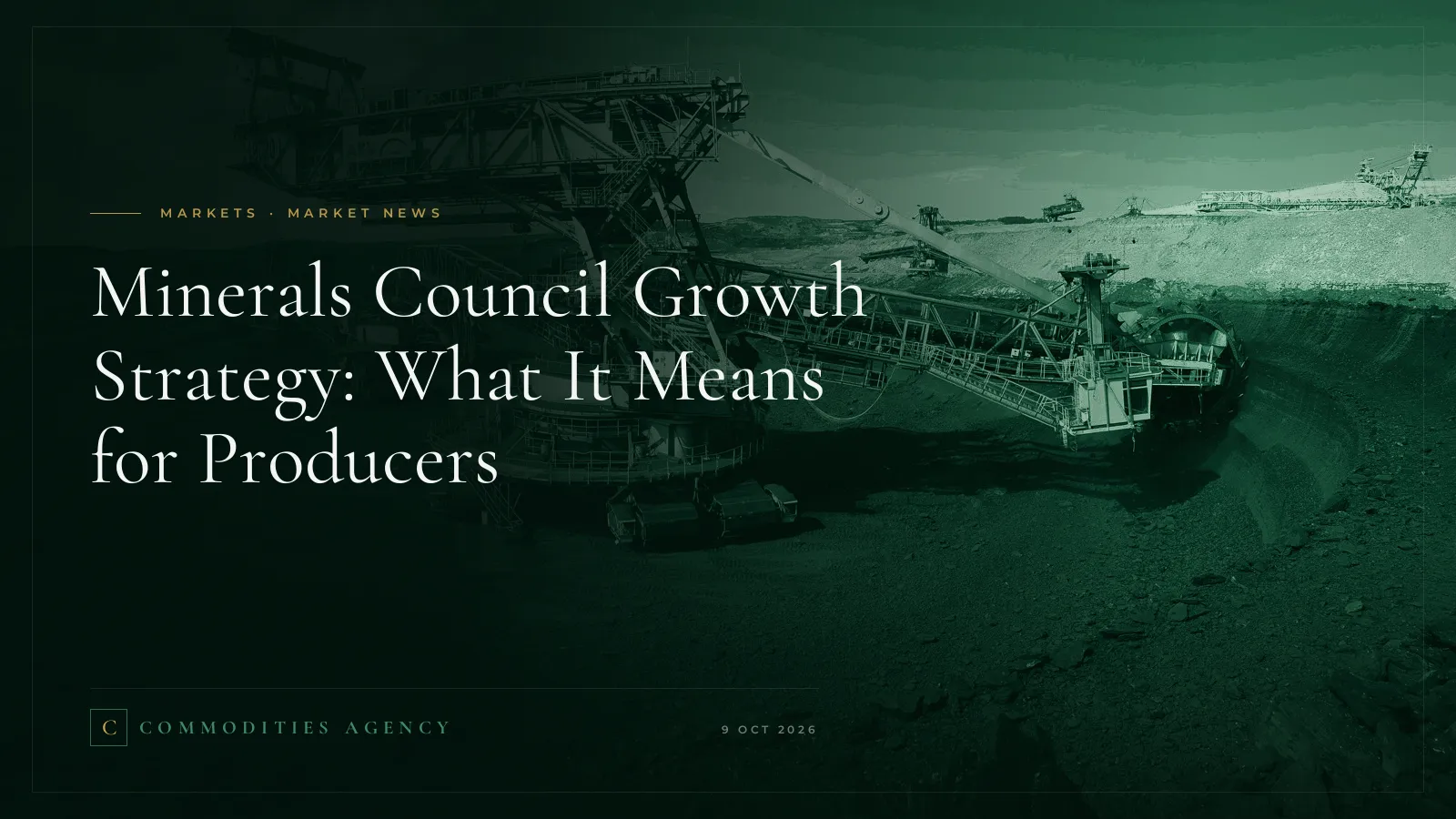
Minerals Council Growth Strategy: What It Means for Producers
The Minerals Council South Africa has launched an investment and growth strategy built around faster permitting and a working mining cadastre. It is a welcome shift in tone, and it tells producers where the next two years of change will and will not come from.
At the Joburg Mining Indaba on 7 October, Minerals Council president Paul Dunne set out a growth and investment strategy for the industry, to be run in partnership with the Department of Mineral and Petroleum Resources. His diagnosis was blunt: "South Africa's mining challenges are not a function of geology, resource quality or investor interest." The constraint, he argued, is the operating and regulatory environment around the industry.
What was announced
The strategy runs as three workstreams agreed with the department. The first targets the administrative bottlenecks that hold projects up, with a stated objective of unlocking more than R50 billion of capital expenditure by February 2028. The second looks at competitiveness and the reforms needed to make South Africa a stronger place to invest. The third supports the national implementation of a mining cadastre, which Dunne said should be completed by March 2027.
The numbers behind it explain the urgency. According to the Minerals Council, about R70 billion of investment is committed and ready for implementation, but most of it is aimed at maintaining current output rather than growing it. Exploration spending has fallen by 80% over the past two decades, and South Africa now attracts less than 1% of global exploration capital. The council estimates that sustained growth of 3% a year could add some R65 billion to GDP and support 50,000 to 100,000 additional jobs by 2035.
Why the cadastre matters more than it sounds
A cadastre is a transparent register of who holds which mining and prospecting rights, and the means to apply for new ones in the open. Its absence has been widely blamed for the backlog of rights and permit applications. For a producer, a working cadastre does two practical things. It shortens the road to new or extended rights, and it makes your own rights position easy for a buyer to verify. That second point is underrated: every serious offtaker runs know-your-customer checks on the source of material, and a clean, visible title shortens that process.
What it does not fix, yet
During the council's consultations, logistics, electricity and water were raised again and again as the infrastructure constraints on growth, alongside crime and illegal mining. Many of these sit outside the mining department's direct control, which is why the council points to the Government-Business Partnership, where mining is one of three priority sectors, as the route to getting them addressed.
For most producers selling chrome, coal, manganese or iron ore today, those are the constraints that decide a deal. Rail allocation, terminal access and the cost of the leg from mine gate to port matter more to this year's revenue than any permitting reform. We cover that leg in detail in how a trade is structured.
What producers can do now
The direction of travel is positive, and the sensible response is to be ready for it. Get your rights and permits documentation in order, because the cadastre will make gaps visible to buyers as well as to regulators. Price your logistics honestly rather than optimistically. And fix the problems that kill deals before you approach a buyer, which we set out in assay, title and port access.
If you are producing or holding material and want to know whether there is a buyer for it at today's prices, tell us what you have. We place chrome concentrate, copper, coal, manganese and iron ore with named international buyers, and we will tell you within a trading day whether your material fits.
Sources
- Minerals Council launches investment, growth strategy for mining industry, Mining Weekly, 8 Oct 2026
- Mining sector's relationship with Mantashe on the rebound, Daily Maverick, 7 Oct 2026
You have the material. We have the buyers.
Tell us the commodity, roughly what grade, how much you hold and where it sits. You will know inside a trading day whether we have a buyer for it.