Copper Cathode and Blister: What Buyers Actually Specify
Cathode, blister and anode price off the same exchange but are not the same purchase. What the specification, weighing basis and payment structure must say.
Copper is the easiest commodity in this market to price and one of the hardest to buy safely. The price is public, quoted continuously on the London Metal Exchange, so nobody in the chain can hide behind a number. What varies, and what determines whether a buyer gets what they paid for, is the specification, the weighing basis and the payment structure.
Cathode, blister and anode are three different purchases
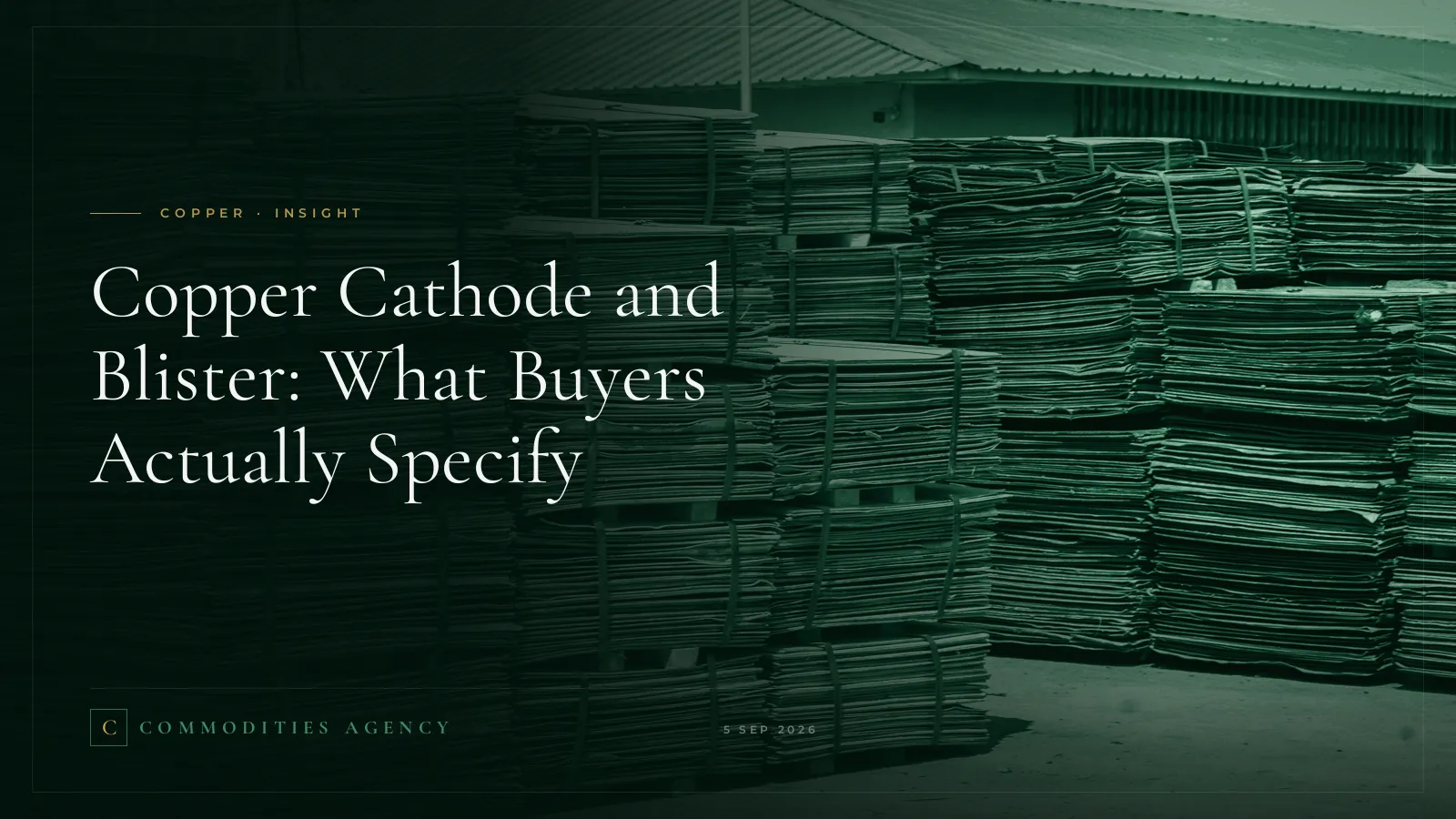
Cathode is refined copper, ordinarily 99.99% Cu, produced by electrowinning or electrorefining and delivered as bundled sheets. This is the product that trades at or near the exchange price, because it needs no further refining before a fabricator can use it. The reference specification most contracts point at is the Grade A standard, which sets limits not just on total copper but on the individual impurities that matter to a wire rod mill: bismuth, selenium, tellurium, lead and sulphur among them.
Blister is unrefined copper, typically in the high 98% range, cast into slabs. It carries impurities that a refinery has to remove, so it sells at a discount that reflects the refining charge the buyer will incur plus a margin for the risk that the impurity profile is worse than declared. Anode copper sits between the two.
The practical point for a buyer is that these are not interchangeable and a discount on blister is not a bargain unless the buyer owns or has contracted refining capacity. A trading house buying blister on the assumption that it can be flipped as cathode is buying a problem.
Specification: name the standard, not just the percentage
A specification that says only 99.99% Cu is incomplete. Two cathodes can both assay 99.99% and behave completely differently in a rod mill because of trace elements measured in parts per million. Contracts should reference a recognised standard for the grade, name the impurity limits that matter for the buyer's process, and state what happens if a delivered lot falls outside them.
In practice the workable structure is a rejection threshold and a penalty band. Material inside the band is accepted with an agreed deduction. Material outside it is rejected and returned or renegotiated, with the cost allocation written down in advance. Leaving that to good faith is how disputes start.
Weight is where value quietly leaks
Copper contracts settle on weight, and weight is determined somewhere. If the contract says weight is final at the load port, the buyer carries every kilogram of loss in transit and every difference between two sets of scales. If it says final at discharge, the seller does. Neither is wrong, but somebody is carrying it and both parties should know which.
The defensible arrangement is independent weighing and sampling at both ends by a named inspection body, with a stated tolerance. Within the tolerance the load port figure governs. Outside it, the parties investigate. That single clause removes the most common cause of a soured first transaction.
Payment: the letter of credit is not a formality
The pattern we see repeatedly is a supplier asking for thirty percent prepayment and seventy percent before shipment. That structure puts the entire performance risk on the buyer and leaves them with nothing to enforce against if the material never loads. For a first parcel with a counterparty the buyer has not dealt with before, it should be declined.
The alternative that works is a confirmed letter of credit payable against delivery documents on arrival, or against shipping documents where the buyer is comfortable with the seller's track record. The instrument protects the seller, because the funds are demonstrably in place before loading, and it protects the buyer, because the seller only gets paid on documents that prove performance.
Before a first parcel we also ask for photographs and video of the stock as it currently sits, and where the value justifies it, a physical inspection at the warehouse or plant. It is a low cost step and it filters out a surprising proportion of enquiries.
Origin and routing out of the Copperbelt
Most African copper originates in the Central African Copperbelt spanning Zambia and the southern Democratic Republic of Congo. From there it has three practical outlets to sea. The Dar es Salaam corridor through Tanzania is the shortest run to an Indian Ocean port. Beira in Mozambique serves the southern part of the belt. Durban is the longest haul but offers the deepest vessel availability and the most mature bonded warehousing in the region.
Route choice should follow the buyer's shipping window rather than the seller's habit. A corridor that is faster on paper is worse in practice if it means the cargo sits waiting for a vessel.
What to send when you enquire
Five things let a copper desk answer usefully: the product and grade you want, the tonnage, the delivery term, the destination, and your target laycan. Everything else is detail that can be settled afterwards. An enquiry without them will get an answer that is equally vague.
Copper
We place copper with named international buyers. Tell us the grade, roughly how much you hold and where it sits, and you will know inside a trading day whether we have a buyer.