Russian Grain into Africa and Asia: Ports and Contract Forms
Russia is the largest wheat exporter in the world and its freight advantage into Africa is structural. How the trade is specified, inspected and contracted.
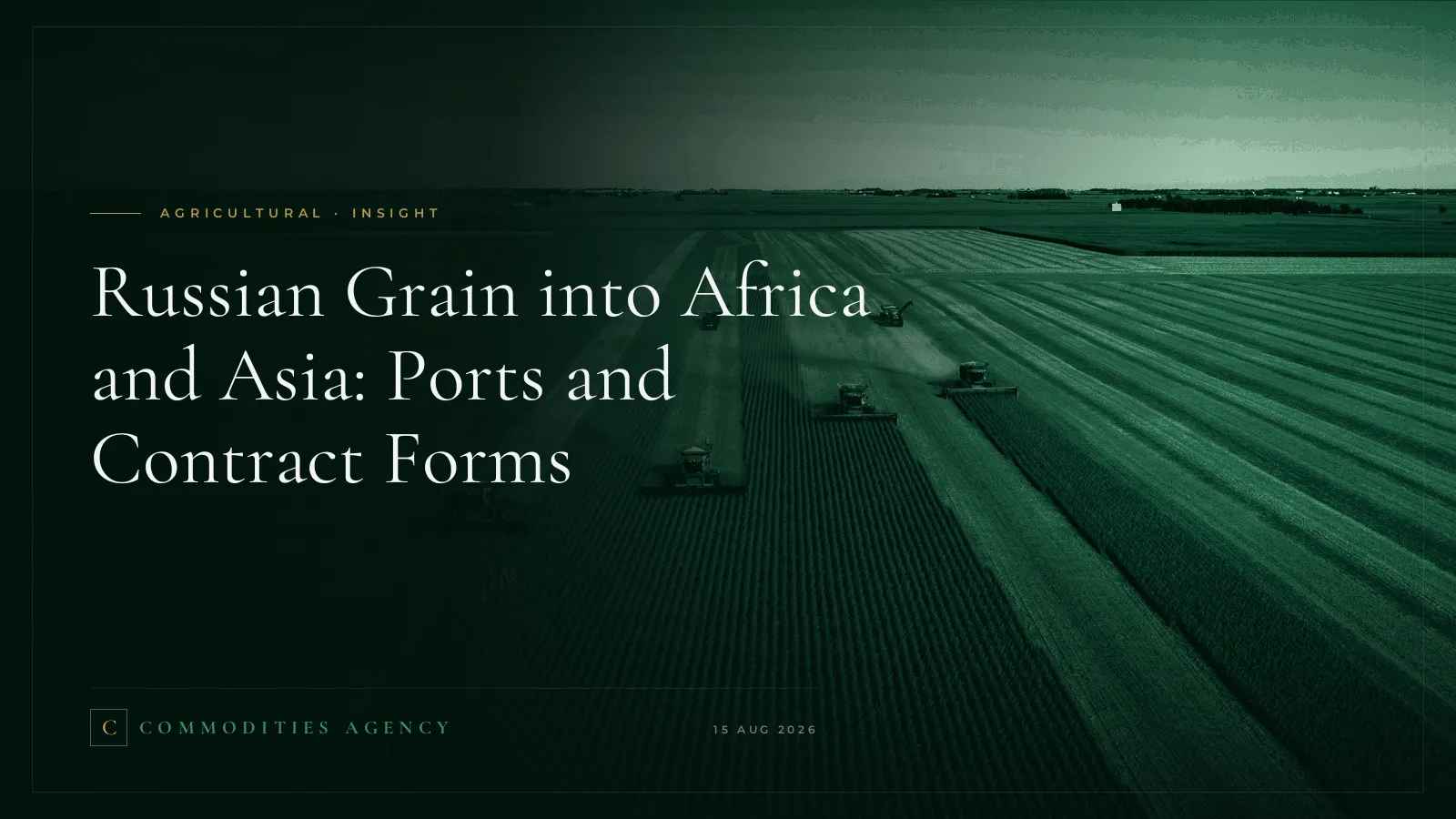
Russian wheat has been the single largest source of internationally traded milling and feed wheat for several years, and the trade into North Africa, East Africa, the Middle East and South Asia rests on something more durable than politics: it is simply closer. A vessel loading in the Black Sea reaches Alexandria, Mombasa or Karachi faster and cheaper than one loading in the Gulf of Mexico or the Pacific Northwest.
What loads, and where from
The main export products are milling wheat, feed wheat, feed barley, maize and sunflower oil, both crude and refined. Loading is out of Black Sea and Azov ports, with the deeper water Black Sea terminals handling Panamax and Supramax parcels and the Azov ports working smaller coasters that suit buyers taking Handysize and below.
Milling wheat is specified on protein content, moisture, test weight and falling number, the last of which measures enzyme activity and tells a miller whether the grain will actually make bread. Feed wheat and feed barley carry looser specifications because they are going into a ration rather than a bakery. Sunflower oil is specified on free fatty acid content, moisture and impurities, and colour.
Trade on the standard forms
This is the single most useful thing to know about the agricultural trade if you have come to it from metals or energy. Grain and oilseed contracts are traded on standard forms published by the Grain and Feed Trade Association and the Federation of Oils, Seeds and Fats Associations. Those forms already answer, with a century of case law behind them, the questions that a bespoke agreement will get wrong.
Quality tolerance, weight franchise, what happens if the vessel is late, who bears the cost of a strike at the load port, how demurrage is calculated and where a dispute is arbitrated are all settled in the form. A negotiation on a GAFTA contract is therefore about a short list of commercial terms: price, quantity, delivery period, load port and payment. Everything else is already written.
A counterparty who insists on drafting a grain contract from scratch is either inexperienced or trying to move a risk that the standard form would have allocated the other way. Both are worth noticing.
Inspection and who decides quality
Quality and weight in this trade are ordinarily determined by an independent surveyor at the load port, with the certificate final except in the case of fraud or manifest error. SGS, Intertek and Control Union are the bodies most commonly named.
Buyers arriving from other commodity markets often want discharge port final, and it is worth understanding why they will struggle to get it. Grain degrades in transit in ways that are not always the seller's fault, and a seller who has loaded a certified cargo cannot control what the vessel's ventilation does over three weeks at sea. Load port final is the market convention and it is not going to move for a single buyer.
Payment and documentation
Letters of credit remain the dominant instrument, with cash against documents used between established counterparties. The documentary package is heavier than in metals: alongside the bill of lading and the certificates of quality and weight there will typically be a phytosanitary certificate, a certificate of origin, a fumigation certificate and often a non genetically modified declaration depending on the destination country's import regime.
Destination import rules are the most common cause of a delayed discharge in this trade. Egyptian, Algerian and Kenyan requirements each differ, and a package that clears one will not automatically clear another. That work belongs at the contract stage, not at the port.
Southern African origin alongside it
We also work white and yellow maize and soybeans of South African and regional origin. That book is seasonal and swings with the rains, moving between surplus and deficit from one year to the next, so timing matters more than it does in the Black Sea trade. When the region is long, it is a competitive origin into the Indian Ocean market. When it is short, the flow reverses.
Agricultural Commodities
We place agricultural commodities with named international buyers. Tell us the grade, roughly how much you hold and where it sits, and you will know inside a trading day whether we have a buyer.