Escrow, Letters of Credit and Why Drawdown Matters
A payment instrument that protects only one side will kill a deal at the last moment. How drawdownable escrow and confirmed letters of credit really differ.
More commodity transactions die at the payment security stage than at any other. Both parties agree the price, the grade and the logistics, and then discover that what the buyer means by a guarantee and what the seller means by one are two different things. It is worth being precise about the mechanics, because the difference is not academic.
The problem being solved
The seller's fear is loading a cargo and not being paid. The buyer's fear is paying and not receiving the cargo, or receiving one that does not meet specification. Every instrument in trade finance is an attempt to close that gap by putting a third party between the two, and they differ in who controls the release of funds and on what evidence.
Escrow that permits drawdown
An escrow account holds the buyer's funds with a third party until agreed conditions are met. The critical question, and the one that gets glossed over in negotiation, is whether the seller can draw against it progressively as it performs, or only at the end.
On a running offtake, a drawdownable escrow is the structure that works. It is funded by the buyer, sized to a defined period of offtake, typically two weeks on a high frequency chain, and it revolves: as the seller draws against delivered tonnage, the buyer tops it back up. A common split is eighty percent released against delivery documents and the remaining twenty percent after testing confirms grade.
That structure works because it matches the seller's cash cycle. A producer delivering a thousand tonnes a week cannot fund a month of production out of working capital while waiting for a single settlement, and asking them to is how a supply agreement quietly stops being performed in month three.
Why a blocked instrument is not a substitute
Buyers frequently offer a bank guarantee, a standby letter of credit or a blocked funds confirmation in place of a drawdownable escrow, and present it as equivalent or better because it comes from a bank. It is not equivalent. An instrument that a seller can only call on in the event of a default, or that requires the buyer's counter signature to release, gives the seller comfort but no cash flow.
For a spot cargo that may be acceptable, because there is only one settlement. For a running contract it is not, and a seller who accepts one is either well capitalised enough not to care or has not thought it through. On our chains we do not accept an instrument that blocks seller drawdown in place of an escrow that permits it.
Where the confirmed letter of credit fits
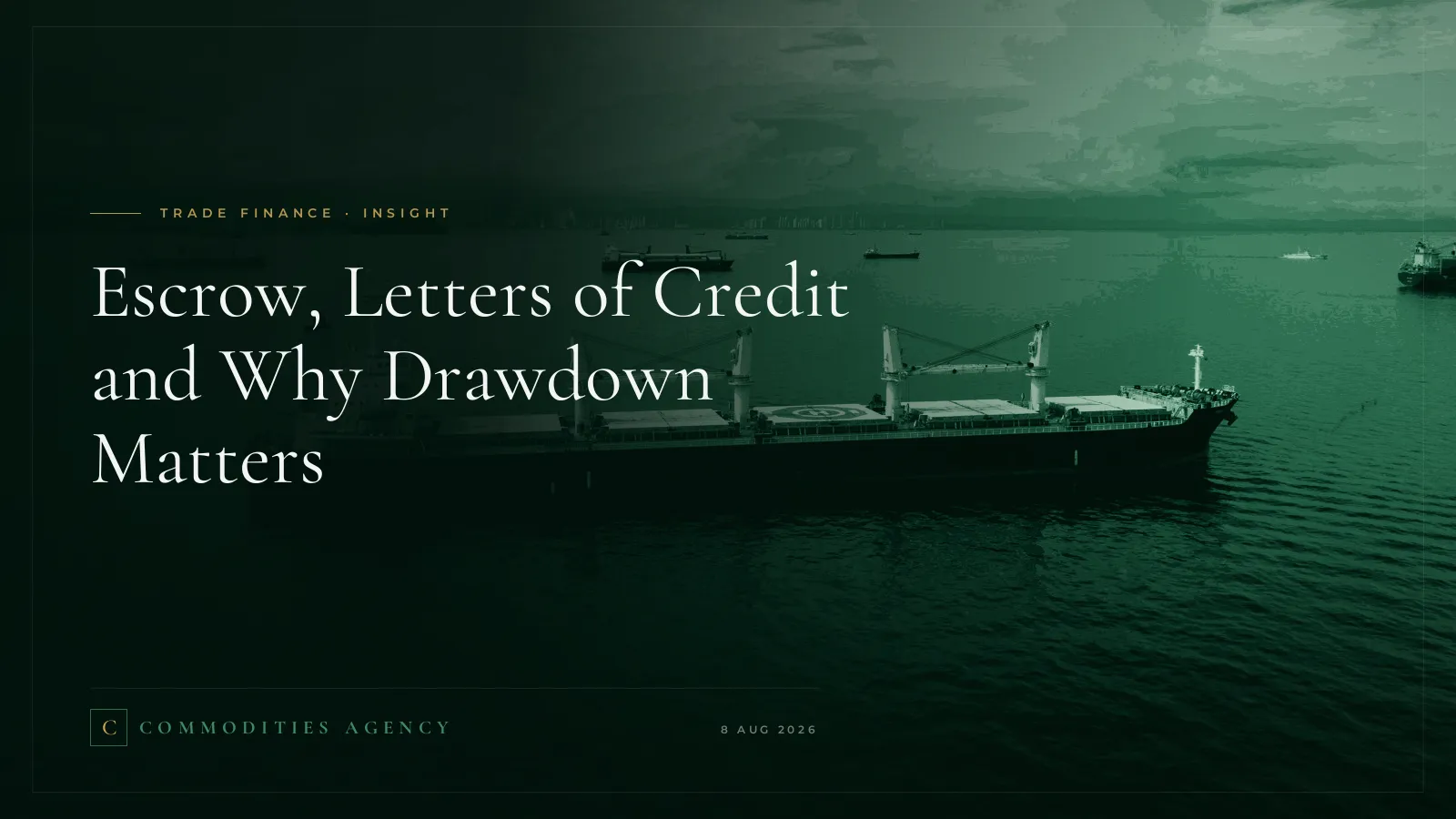
For a single seaborne cargo the documentary letter of credit remains the workhorse, and for good reason. The bank pays against documents, not against the cargo, which means the seller is paid on proof of shipment and the buyer's bank has checked that the documents conform before releasing funds.
Two words carry most of the weight. Confirmed means a second bank, usually in the seller's jurisdiction, adds its own undertaking, so the seller is not relying on a bank it cannot assess in a country it cannot enforce in. Irrevocable means the buyer cannot withdraw it unilaterally. A letter of credit that is neither is a letter of intent with a bank letterhead.
Escrow platforms are not escrow
A word of caution. There is a category of online transactional escrow platform that markets itself into commodity trading and is not remotely equipped for it. These are payment intermediaries, not regulated escrow agents, and their terms typically allow them to freeze or reverse funds on their own assessment. We exclude them expressly from our contracts and recommend that any counterparty do the same. Where an escrow is to be used, the provider should be a bank or a regulated escrow agent, named and accepted in writing by both sides.
Cost schedules justify the size
One practical technique worth adopting. When a seller asks a buyer to fund an escrow, the buyer's immediate question is why that number. Including an estimated cost schedule in the contract, showing what it actually costs the seller to produce and deliver the contracted tonnage over the escrow period, turns the figure from a demand into an arithmetic result.
It has a second benefit. Once a buyer can see the production economics, the conversation about scaling volume becomes much easier, because they can work out for themselves what a larger commitment would require.
Getting it right early
Payment security should be agreed in principle before the specification is finalised, not after. It is the term most likely to be a dealbreaker, and discovering that at the signature stage wastes weeks of work on both sides. Ask the question early and take the fast no.
You have the material. We have the buyers.
Tell us the commodity, roughly what grade, how much you hold and where it sits. You will know inside a trading day whether we have a buyer for it.