Coal Logistics: Maputo against Richards Bay
Richards Bay runs on entitlement and Capesize economics. Maputo runs on road, rail and smaller vessels. Which terminal suits your cargo, and why.
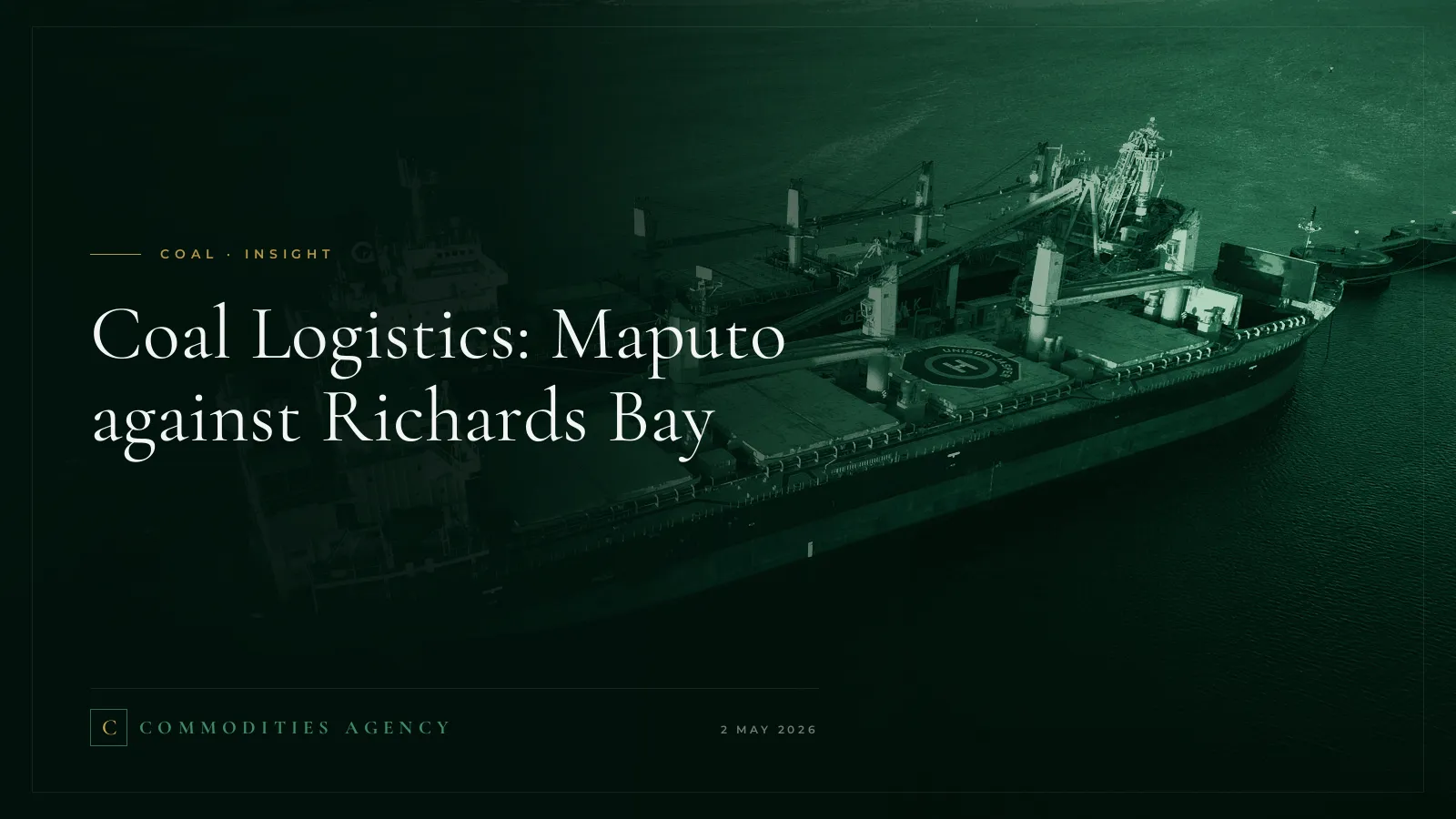
Every South African coal export decision comes down to a terminal choice before it comes down to a price. Richards Bay Coal Terminal and Maputo Port serve the same coalfields and the same buyers, but they are not interchangeable, and a seller who picks the wrong one will discover it at the worst possible moment.
Richards Bay: scale, index and entitlement
Richards Bay Coal Terminal is one of the largest dedicated coal export facilities in the world and the physical basis of the API4 index. That last point matters more than tonnage. Because the index is assessed free on board Richards Bay, a cargo loading there prices against a published number that both parties can check, which removes an entire category of argument.
The terminal operates on an entitlement system. Capacity is allocated, and a seller without an allocation cannot simply arrange a train and turn up. This is the single most common reason a South African coal offer collapses: the tonnes exist, the grade is right, and there is no route to the ship. Any offer originating at Richards Bay should be able to state whose entitlement it is loading against.
The upside for those who have access is vessel economics. Richards Bay handles Panamax and Capesize, and on long haul routes into India and East Asia the freight saving of a Capesize over a Supramax is substantial enough to decide a trade on its own.
Maputo: access without entitlement
Maputo Port in Mozambique has become the practical outlet for South African coal that has no Richards Bay allocation. It handles material arriving by rail and by road, and it works at Supramax and small Panamax sizes rather than Capesize.
The trade off is a different cost stack. Road haulage into Maputo costs more per tonne than rail into Richards Bay, border crossing adds time and paperwork, and the smaller vessel means a higher freight cost per tonne on a long voyage. Against that, the tonnage moves at all, which for a seller without entitlement is the only comparison that matters.
There is also a buyer side case. A buyer who wants 30,000 MT rather than 55,000 MT cannot easily be served out of Richards Bay, because the cargo does not fit the vessel classes the terminal is built around. Maputo makes those parcels possible.
How to choose
Three questions settle it in most cases. Does the seller hold Richards Bay entitlement, or contracted access to somebody who does? What size cargo does the buyer actually want, and does it justify a Panamax? And how long is the voyage, because freight per tonne on a Supramax to India is a very different number from a Capesize on the same route.
If the answer to the first question is no, the second and third are academic. Maputo is the route. If the answer is yes and the cargo is Panamax or larger on a long haul, Richards Bay will almost always win on delivered cost.
What both routes require of a seller
Regardless of terminal, the documentation and verification burden is the same. A certificate of analysis from a named independent body, a demonstrable rail or road programme that matches the laycan, a stated terminal arrangement, and a payment instrument that both sides can live with. Sellers who can produce the first three quickly are usually the ones who can perform. Those who defer them are usually not close enough to the physical coal.
A note on stated laycans
Laycan slippage is endemic in South African coal and it is almost always a rail problem rather than a mine problem. When we circulate a coal offer we ask for the seller's rail programme, not just its stated laycan, because the two are frequently different documents telling different stories. A buyer fixing a vessel against an optimistic laycan carries demurrage that nobody budgeted for.
Thermal Coal
We place thermal coal with named international buyers. Tell us the grade, roughly how much you hold and where it sits, and you will know inside a trading day whether we have a buyer.